Logistics Operations
Real-Time Logistics Operations Platform
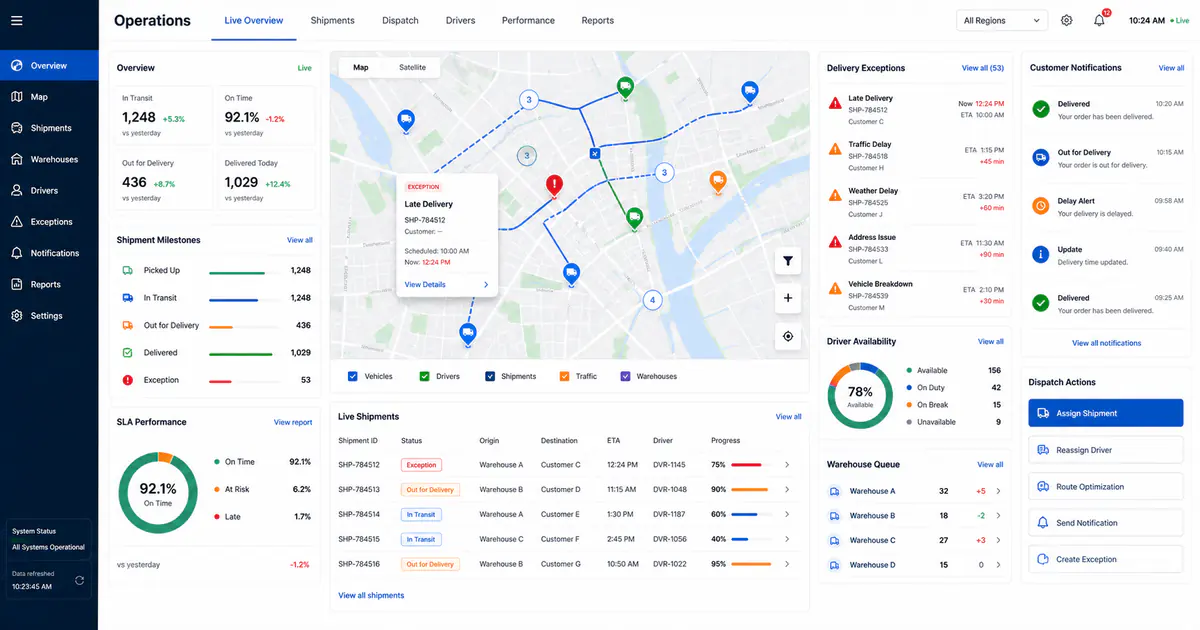
A real-time logistics platform for shipments, dispatch, fleet status, warehouse queues, delivery exceptions, notifications, SLA reporting, and admin control.
Project overview
This logistics operations platform gave dispatchers, warehouse teams, support agents, and administrators one current view of shipments from pickup through delivery. It combined shipment milestones, route and driver status, warehouse queues, delivery exceptions, customer notifications, service-level performance, and operational reports without introducing automated or AI-based decisions.
I led the event model, real-time synchronization, map and exception experience, privacy boundaries, and admin controls. The product emphasized reliable facts and accountable dispatcher actions: the system surfaced current conditions, while people made reassignment and exception decisions.
Problem statement
Shipment updates arrived from warehouse scans, driver devices, carrier integrations, and support actions. These sources used different status names and sometimes delivered events late or out of order. Dispatchers watched several screens, customers contacted support for basic status, and a delayed shipment could remain hidden inside a large healthy queue.
The platform needed one canonical milestone history, resilient ingestion, prioritized exceptions, clear freshness, and customer communication tied to confirmed operational events. Field location also needed strict purpose and retention limits.
Solution and event architecture
Node.js ingestion services normalized carrier, warehouse, and driver events into a common shipment model. MongoDB stored canonical shipments and an append-only event stream. Redis distributed accepted events between WebSocket gateways and cached current operational summaries. PostGIS supported service areas, route geometry, and nearby assignment queries.
Every source event used a stable identifier, source time, received time, and sequence context. Transition rules prevented a delayed message from moving a delivered shipment backward:
if (canApply(current.status, event.type, event.sourceTime)) {
  await appendShipmentEvent(shipmentId, event);
  await projectCurrentShipment(shipmentId);
}
Next.js server-rendered the initial operations state, then subscribed to authorized regional channels. Reconnecting clients requested events after their last acknowledged sequence before resuming live updates.
Capabilities delivered
- Live shipment, milestone, route, warehouse, driver, and service-area views.
- Exception queues for delay, address, failed attempt, capacity, and breakdown.
- Dispatcher assignment, reassignment, escalation, and resolution workflows.
- Warehouse intake, ready, delayed, loading, and handoff queues.
- Customer notifications generated from confirmed milestone and exception events.
- On-time delivery, exception age, throughput, workload, and SLA reports.
Key engineering decisions
Real-time messages were treated as a delivery mechanism, never the system of record. The dashboard showed data freshness and distinguished a device that was offline from a vehicle that had stopped. Disposable map-position events yielded to durable milestone and exception events when gateways experienced backpressure.
Location was captured only during an active delivery shift and retained at reduced precision after the operational window. Support roles saw shipment progress and estimated timing, not a driver's complete path. Every manual status override required a reason and produced an audit event. Route suggestions remained optional information for dispatchers rather than automatic assignments, preserving human review for capacity, safety, and local constraints.
Delivery and validation
Event fixtures covered duplicate scans, out-of-order milestones, carrier retries, failed attempts, address corrections, reassignment, split shipments, returns, and cancellation. Load tests reproduced morning warehouse bursts and end-of-day delivery completions. Multi-client tests verified that dispatch, support, and customer views converged after reconnect and replay.
The rollout started with one region and a controlled shipment group. Dashboards monitored ingestion lag, event rejection, WebSocket replay, stale devices, exception ownership, notification delivery, and map-query latency. Dispatchers rehearsed carrier outage, warehouse backlog, device loss, and regional failover procedures. Accessibility checks included map alternatives, searchable shipment tables, keyboard dispatch actions, status announcements, and non-color exception labels. Privacy tests verified active-shift limits and scheduled location deletion.
Outcomes
Prioritized exception ownership reduced median response time by 34%. Better warehouse visibility and dispatcher coordination improved on-time delivery by 17% during the measured rollout. Proactive, milestone-based notifications reduced customer status contacts by 41%.
Operations teams could trace why a shipment changed state and which source supplied the update. Customers received clearer communication, while privacy controls limited field tracking to the period and roles that genuinely required it.
Related work
Real-time synchronization builds on the collaborative planning platform. Operational workforce concepts relate to employee attendance and tracking, while delivery practices appear in DevOps automation tools for modern delivery.