Employee Management System
Employee Attendance Payroll Tracking
An employee management admin platform unifying attendance, shifts, leave, payroll, payments, field-team tracking, approvals, compliance, and audit reporting.
Project overview
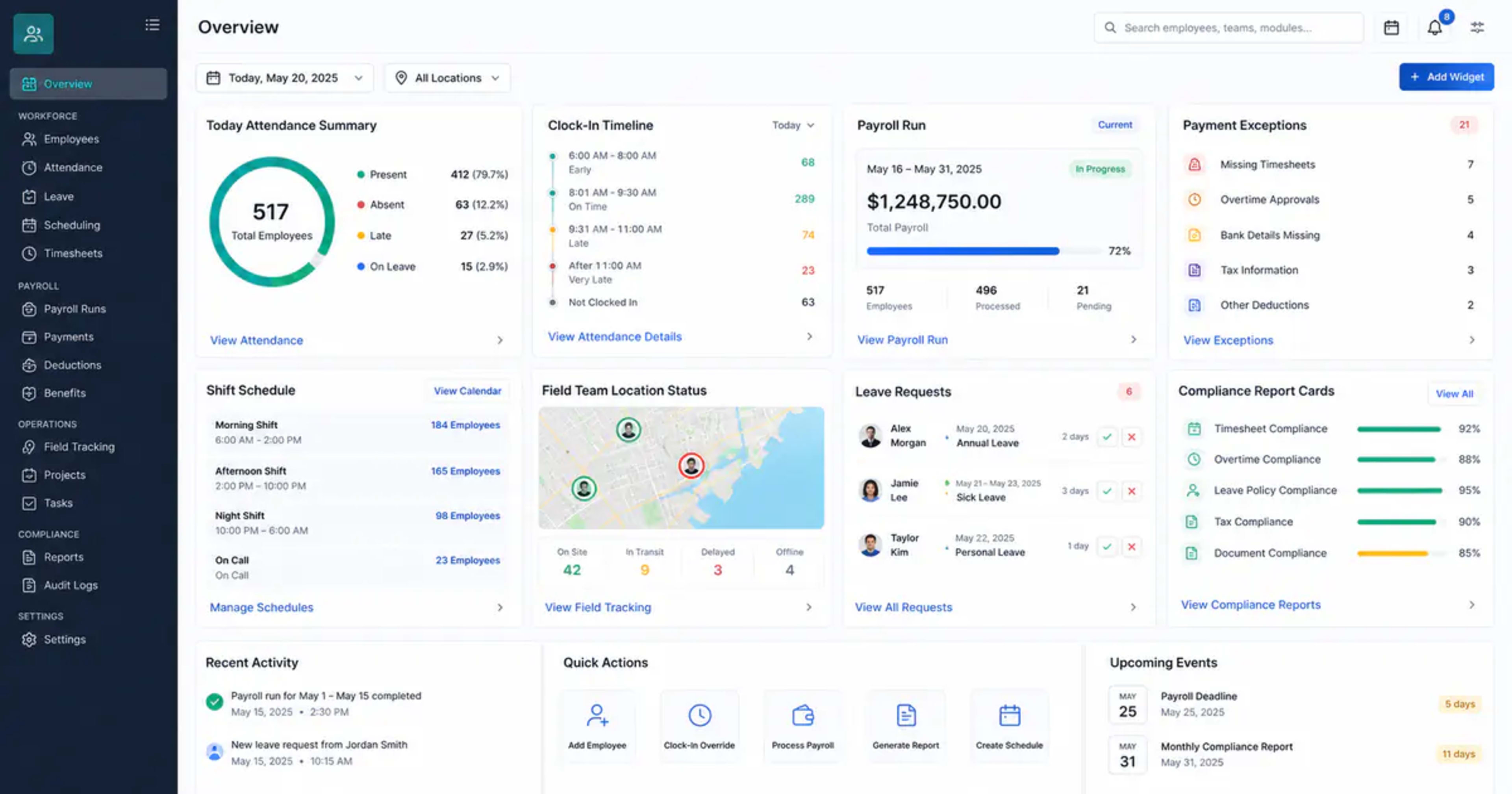
This employee management system gave administrators one secure workspace for people records, attendance, shifts, timesheets, leave, payroll, payments, field operations, and compliance. The project replaced disconnected spreadsheets and manual approvals with traceable workflows while preserving clear boundaries between HR, payroll, managers, and operational supervisors.
I led the domain design, administrator experience, payroll preparation workflow, field-status model, permissions, and audit architecture. The product treated workforce data as sensitive operational information, not a general analytics feed.
Problem statement
Attendance arrived from multiple locations and was reconciled only before payroll. Missing clock-outs, unapproved overtime, leave overlaps, and outdated bank or tax information appeared late, creating a stressful correction cycle. Field supervisors reported team status through messages, while administrators could not distinguish a delayed worker from an offline device or an unsubmitted update.
The platform needed an explainable path from raw attendance to approved payable time. It also needed focused exception queues, privacy-conscious field tracking, role-based access, and immutable evidence for payment and compliance reviews.
Solution and workforce model
Angular and Bootstrap delivered responsive administration modules for attendance, schedules, payroll, employees, leave, field operations, and reports. Java services applied attendance and payroll rules, while SQL transactions stored employment terms, shift assignments, punches, timesheets, approvals, payroll runs, payment references, and audit events with clear relational integrity.
Attendance rules converted raw punches into proposed payable segments but never silently edited the source record:
const timesheet = calculateTimesheet({
  punches,
  shift,
  leave,
  overtimePolicy,
});
await saveProposedTimesheet(timesheet);
Managers reviewed exceptions before payroll locked a period. A payroll run stored the approved inputs, calculation version, deductions, additions, totals, and payment status so later rule changes could not alter historical payslips.
Capabilities delivered
- Employee profiles, employment status, documents, teams, and role assignments.
- Shift scheduling, attendance capture, missing-punch review, and overtime approval.
- Leave requests, balances, policy checks, delegation, and calendar visibility.
- Payroll preparation, deductions, additions, payment exceptions, and payslips.
- Field-team status for on-site, in transit, delayed, offline, or completed work.
- Compliance reports, exports, audit logs, and time-bound administrative access.
Key engineering decisions
Field tracking recorded status at assigned work events rather than continuously following employees. Precise location was visible only to authorized operational roles during an active assignment and retained for a limited period. The interface always distinguished “no recent update” from “not present,” preventing network loss from becoming an attendance judgment.
Payroll calculation functions were deterministic and covered by scenario fixtures for overtime, leave, partial shifts, retroactive adjustments, and final settlement. Manual changes required a reason and separate approval above a configured threshold. Sensitive bank, tax, and salary fields were encrypted and omitted from general logs, exports, and search indexes.
Delivery and validation
Payroll fixtures represented overnight shifts, holidays, overtime tiers, unpaid breaks, leave overlap, retroactive changes, joining, separation, deductions, reimbursements, and rounding. Every release recalculated those scenarios and compared exact minor-unit totals. Permission tests covered employees, supervisors, HR, payroll, finance approval, auditors, and temporary administrators.
The system launched with attendance and exception review before payroll payments were activated. Two parallel payroll cycles compared new calculations with the approved legacy process. Dashboards tracked missing punches, approval age, calculation differences, payment failure, export access, and field-status freshness. Accessibility review included tables, date controls, form errors, and keyboard approvals. Privacy testing verified location expiry, masked salary fields, redacted logs, restricted exports, and immediate removal of terminated access.
Outcomes
Precomputed exceptions and period locking reduced payroll preparation time by 67%. Guided missing-punch and overtime workflows cut timesheet corrections by 39%. Daily attendance review became 52% faster because administrators worked from prioritized issues instead of scanning every employee.
The system created a defensible history from attendance through payment while giving managers practical scheduling and field status. Employees received more consistent records, and payroll teams spent less time reconstructing approvals from messages.
Related work
The permission and audit model extends the health marketplace admin panel. Field workflows relate to the El Cateo farm management platform, while security controls follow cybersecurity best practices for developers.