Agritech and Farm Operations
El Cateo Farm Management Platform
An avocado farm management platform for crop records, orchard blocks, irrigation, quality checks, field tasks, harvest forecasts, and real-time issue tracking.
Project overview
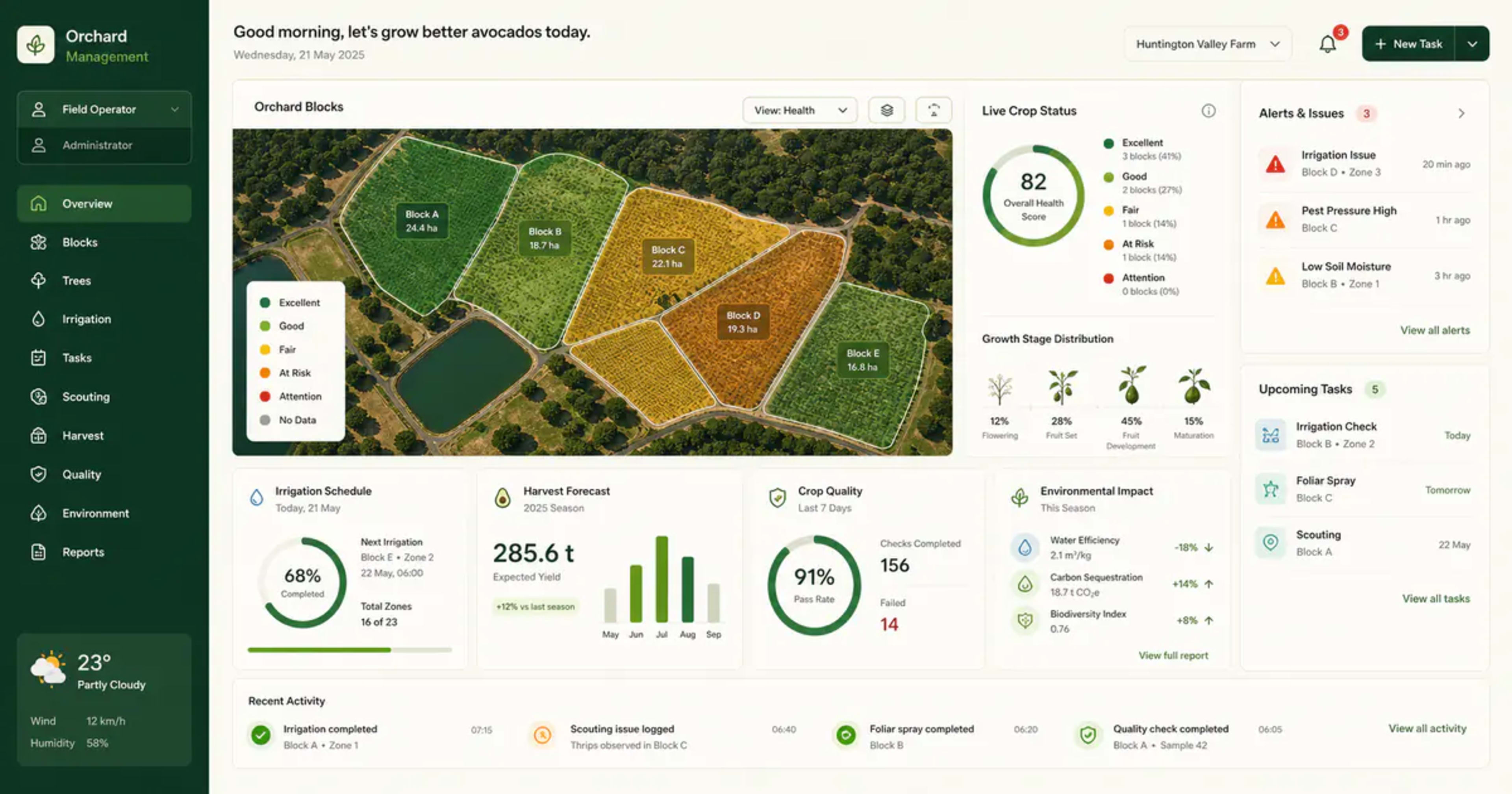
El Cateo describes technology-assisted avocado cultivation, crop-quality monitoring, growth records, and real-time problem diagnosis. This farm management platform turned those operational needs into a field-friendly application for workers and an administrative control center for managers. It connected orchard blocks, trees, irrigation zones, crop observations, tasks, quality checks, harvest forecasts, and environmental records.
I led the information model, offline workflow, map experience, admin reporting, and cloud delivery. The application was designed for a farm environment where connectivity, gloves, sunlight, and short observation windows affect usability as much as database architecture.
Problem statement
Field observations were recorded across notebooks, photos, messages, and spreadsheets. That made it difficult to compare tree health over time, determine whether an irrigation issue had been resolved, or connect quality results with a specific orchard block and harvest. Managers often learned about a problem after a shift rather than when corrective work was still practical.
The new system needed fast mobile capture, reliable offline behavior, map-based context, traceable crop interventions, and reporting that supported quality and environmental responsibility without burdening field workers with long forms.
Solution and architecture
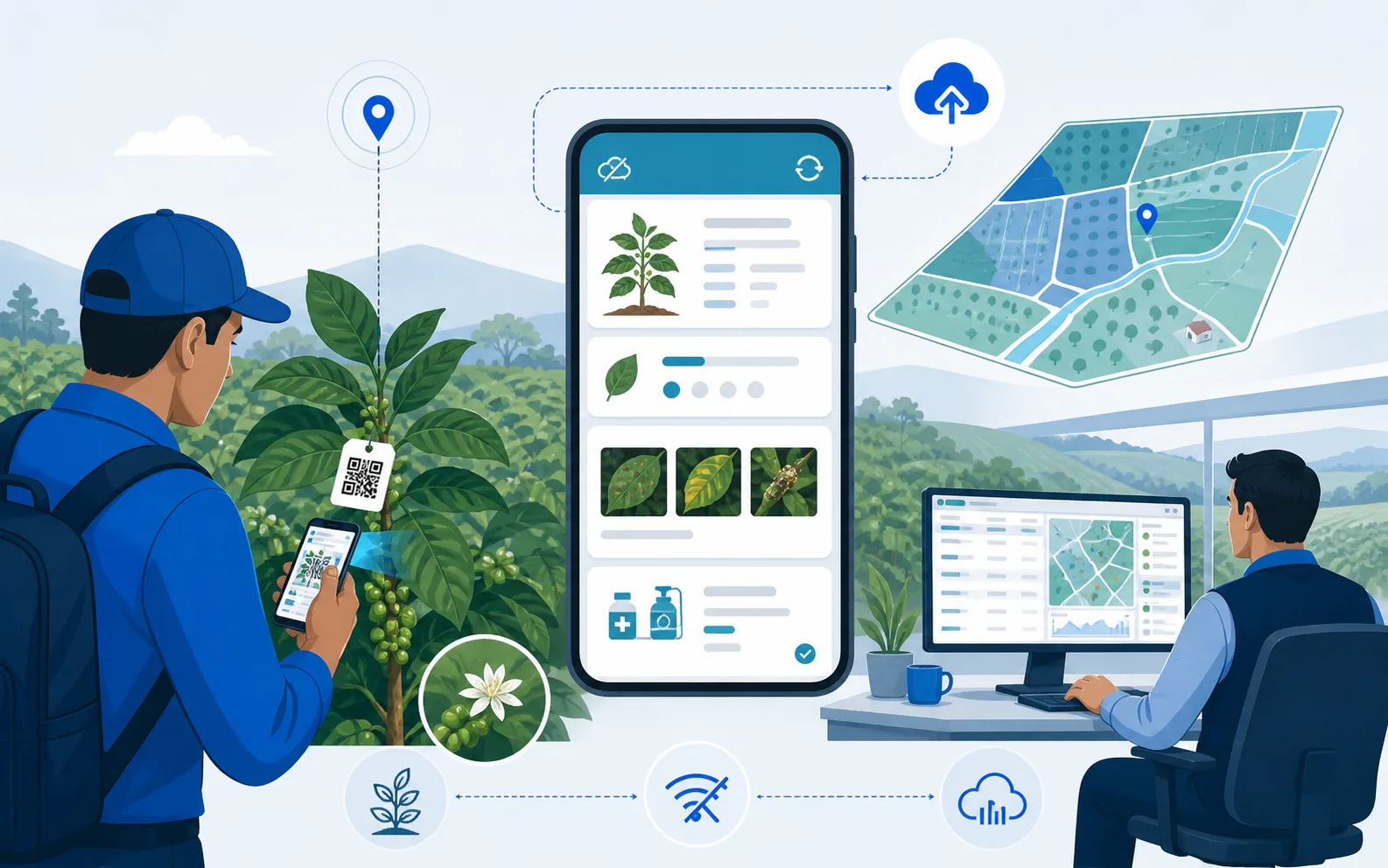
React Native delivered an offline-capable field application with high contrast, large targets, concise labels, and clear synchronization states. Realm Mobile Database stored observations, tasks, and pending mutations securely on each device so field work continued without a connection. A React administration dashboard supported planning and analysis.
Node.js and Express.js APIs coordinated synchronization and background workflows. MongoDB remained the canonical store for farms, blocks, tree groups, observations, tasks, irrigation events, quality samples, harvest lots, and map boundaries. Stable mutation identifiers made Realm-to-MongoDB synchronization idempotent and kept retries from creating duplicate field records.
Every observation retained the field time, author, block, crop stage, optional coordinates, media references, and sync state:
await observations.upsert({
  mutationId,
  blockId,
  observedAt,
  condition,
  notes,
});
Photos uploaded to private S3 paths after structured data synchronized, preventing weak connectivity from blocking the core record. Background workers generated reminders, forecast summaries, and unresolved-issue escalation.
Capabilities delivered
- Orchard block map with health, irrigation, task, and harvest layers.
- Tree growth and crop-stage observations with photos and structured conditions.
- Irrigation schedules, completion records, exceptions, and water-use summaries.
- Field task assignment, offline completion, review, and recurring work templates.
- Quality sampling connected to block, harvest lot, date, and responsible team.
- Harvest forecasts, issue alerts, activity history, and environmental reporting.
Key engineering decisions
The platform distinguished an observation from a diagnosis. Field workers could record visible conditions quickly; authorized agronomy or management roles added diagnoses and treatment decisions later. This preserved raw evidence and avoided presenting an early interpretation as fact.
Offline changes used stable mutation identifiers, and users could see pending, synchronized, or conflicted states. Location capture was optional and limited to work records rather than continuous worker tracking. Forecasts displayed assumptions and confidence ranges, not a single guaranteed yield. Historical quality and treatment records were append-only after approval, ensuring that later edits did not rewrite the story of a harvest lot.
Delivery and validation
Field trials measured task completion in bright sunlight, with gloves, on narrow screens, and through repeated connection loss. Test scenarios covered duplicate observations, overlapping block boundaries, delayed photographs, recurring tasks, irrigation exceptions, reassigned work, mixed harvest lots, and rejected quality samples. Synchronization tests verified that a retry never created a second observation.
The rollout began with a small set of orchard blocks and expanded after field operators reviewed terminology and form length. Dashboards tracked pending sync, stale issues, incomplete tasks, missing quality samples, and integration health. Administrators rehearsed export, restoration, and device-loss procedures. Accessibility checks focused on contrast, touch size, icon labels, and non-color condition indicators. Seasonal reports were compared with source records before they became operational references.
Outcomes
Structured mobile capture reduced average field reporting time by 44%. Irrigation schedules and completion evidence lowered block-to-block water-use variance by 22% during the measured period. Prioritized issue alerts and ownership shortened response time by 31%.
Managers gained a current operational view without waiting for spreadsheet consolidation. Field teams spent less time duplicating notes, while quality and harvest records became easier to trace back to the orchard conditions and work that produced them.
Related work
Offline synchronization choices relate to the personal finance mobile app. Operational dashboards connect to the employee attendance and payroll platform and serverless cloud architecture guide.