Cloud Computing
Serverless Computing Trends for Cloud Apps
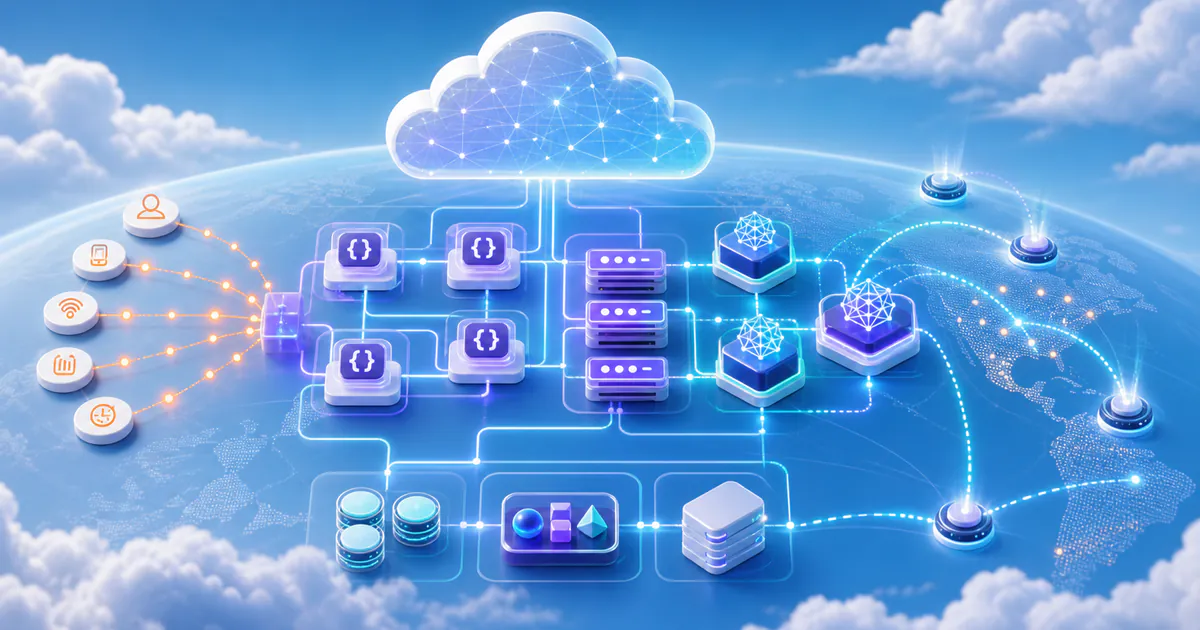
Serverless computing trends are moving beyond simple function-as-a-service demos. Modern teams now use serverless platforms for APIs, scheduled jobs, file processing, AI workflows, realtime triggers, and edge personalization. The appeal is clear: developers can ship business logic without managing servers, capacity planning, or patch cycles.
Serverless does not mean infrastructure disappears. It means infrastructure decisions move into configuration, architecture, observability, and cost control. The best teams treat serverless as an operating model, not just a deployment target.
Trend 1: Edge Functions
Edge functions bring compute closer to users. They are useful for authentication checks, redirects, personalization, A/B testing, geolocation, and lightweight API responses.
Good edge workloads are:
- Small and latency-sensitive.
- Stateless or nearly stateless.
- Close to the request and response path.
- Safe to run with strict execution limits.
Heavy processing, large dependencies, and long-running jobs usually belong in regional functions, containers, or queues.
Trend 2: Event-Driven Architecture
Serverless fits event-driven systems naturally. A user uploads a file, a payment succeeds, a database record changes, or a message arrives in a queue. Each event can trigger focused work.
export async function handlePaymentSucceeded(event) {
  await createInvoice(event.customerId);
  await sendReceiptEmail(event.customerEmail);
  await updateSubscription(event.subscriptionId);
}
The benefit is separation. Billing, email, analytics, and fulfillment do not need to live inside one large request cycle.
Trend 3: Serverless AI Workloads
AI features are pushing serverless platforms in new ways. Some workloads need fast streaming responses. Others need background processing, embeddings, vector search, or batch summarization.
Serverless works well for:
- Chat and support endpoints.
- Document summarization.
- Image or text classification.
- Embedding generation after content updates.
- Scheduled content analysis.
Watch out for timeouts, cold starts, model latency, and unpredictable cost. AI workloads should include limits, queues, retries, and usage tracking.
Trend 4: Better Developer Experience
Developers expect serverless workflows to feel local, testable, and observable. The ecosystem is improving around local emulation, preview deployments, infrastructure-as-code, and integrated logs.
Strong serverless teams invest in:
- Repeatable environments.
- Clear deployment pipelines.
- Structured logs and tracing.
- Alerting for failed events.
- Documentation for function ownership.
Serverless can become hard to reason about when dozens of functions exist without a map.
Trend 5: Cost Awareness
Serverless pricing is powerful because teams pay for usage. It can also surprise teams when traffic patterns, retries, storage, and data transfer are not monitored.
Practical cost controls include:
- Set concurrency limits on expensive functions.
- Batch non-urgent jobs.
- Cache public responses.
- Delete unused functions and schedules.
- Track cost by service or product area.
Common Serverless Mistakes
Serverless apps become difficult when every feature creates a new function without naming, logging, or ownership conventions. A distributed system still needs structure.
Avoid these mistakes:
- Putting large business workflows inside one request.
- Retrying failed events without limits.
- Shipping functions with oversized dependencies.
- Forgetting idempotency for payment or email events.
- Creating queues without dead-letter handling.
- Treating logs as optional.
Small functions are helpful only when the overall system remains understandable, observable, documented, and simple enough for new teammates to operate. Clarity prevents incidents.
Related Reading
- Benefits of Next.js for Modern Web Development
- Cloud Cost Optimization for Engineering Teams
- DevOps Automation Tools for Modern Delivery
Final Thoughts
Serverless computing trends point toward faster product delivery, but success depends on architecture discipline. Use edge functions for latency, event-driven workflows for decoupling, serverless AI for focused automation, and observability for confidence. Serverless is strongest when every function has a clear purpose.
Keep reading
Related blogs
Cloud Computing
Cloud Cost Optimization for Engineering Teams
Reduce cloud costs with FinOps, autoscaling, storage cleanup, serverless tuning, observability, right-sizing, and smarter architecture decisions in 2026.
Read related article
Software Engineering
Future of Full-Stack Development in 2026
Explore the future of full-stack development with AI copilots, serverless, edge apps, type-safe APIs, cloud platforms, automation, and product teams in 2026.
Read related article
DevOps
DevOps Automation Tools for Modern Delivery
Compare DevOps automation tools for CI/CD, IaC, observability, containers, security checks, release governance, and reliable delivery pipelines in 2026.
Read related article
Web Development
AI in Next.js Development for Modern React Apps
Learn how AI in Next.js development improves React apps with server components, edge functions, automation, smarter UX, and full-stack delivery in 2026.
Read related article
AI and Machine Learning
Generative AI Architecture for Production Apps
Build production generative AI apps with secure LLM gateways, prompt management, observability, evaluation, caching, and scalable deployment patterns.
Read related article