Sports Management Platform
2Legit Volleyball Player Management
A volleyball management platform for athletes, parents, coaches, and admins, covering programs, attendance, development plans, memberships, teams, and events.
Project overview
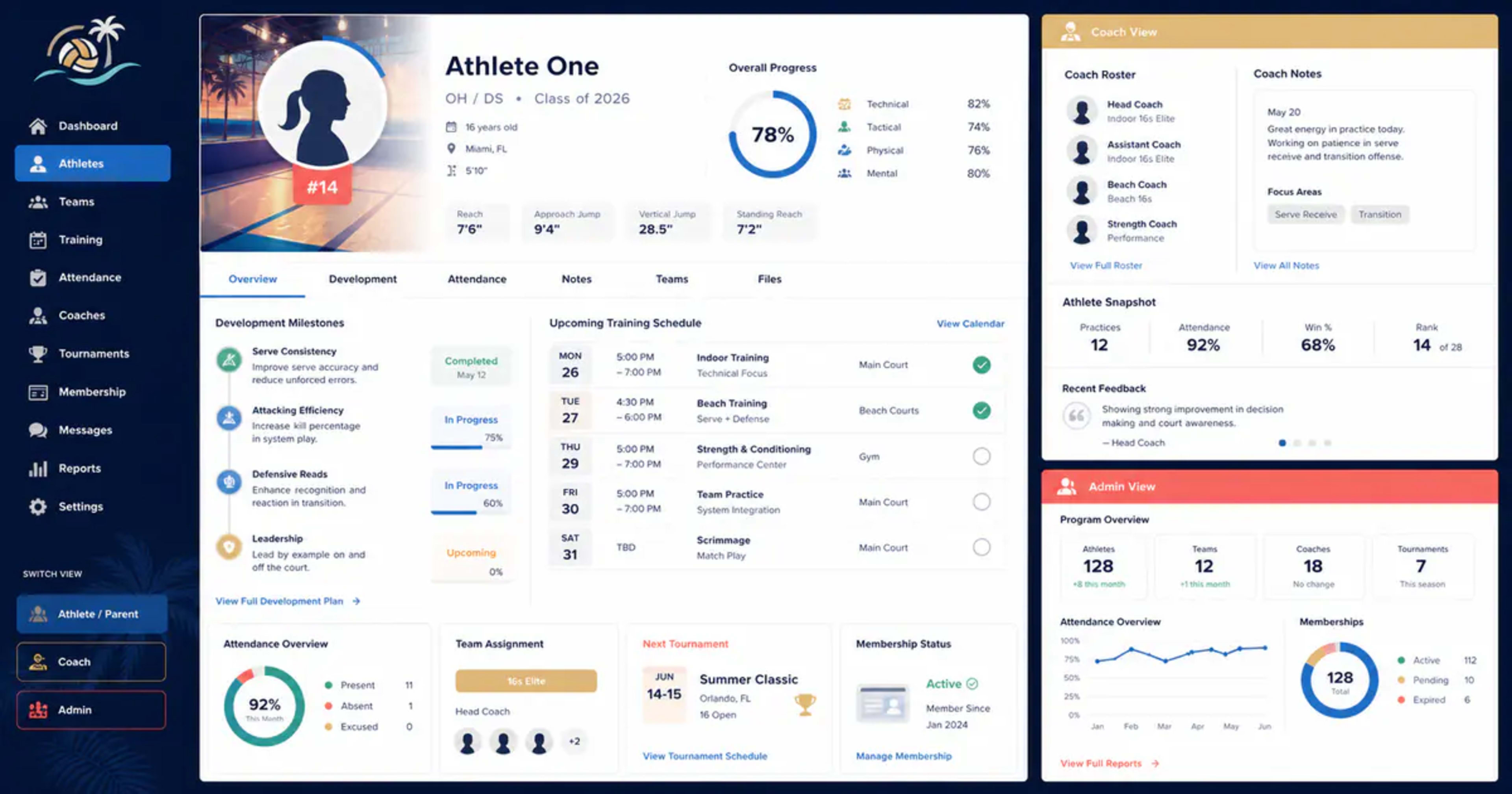
2Legit Volleyball offers indoor and beach programs, private training, tournaments, memberships, and athlete development in Miami. The management platform organized those connected activities for athletes and parents, coaches, and club administrators. It provided one record for registration, program participation, attendance, team assignment, development goals, membership status, communication, and event readiness.
I translated the public program structure into role-specific operational workflows. The athlete experience emphasized schedules and progress; coaches received roster, attendance, notes, and planning tools; administrators managed programs, memberships, events, permissions, and reporting.
Problem statement
Sports programs generate information across forms, messages, calendars, spreadsheets, and payment records. Coaches need current rosters at the court, families need reliable schedule changes, and administrators need to know whether an athlete is registered, paid, assigned, and eligible. Development notes can become inconsistent when every coach uses a separate format.
The platform needed to support athletes across indoor and beach programs without duplicating profiles. It also had to protect minors' information, separate coach and administrative permissions, and make progress feedback constructive rather than turning young athletes into rankings.
Solution and data model
Angular delivered responsive athlete, coach, and admin workspaces. Bootstrap components expressed training schedules, attendance states, development milestones, membership status, and event readiness consistently. Node.js APIs coordinated registration and attendance workflows, while SQL preserved the relationships among people, guardians, programs, seasons, sessions, teams, assessments, and payments.
A registration connected an athlete with a program season while the athlete profile remained stable across years. Coach access was derived from current team and program assignments:
const canViewAthlete = await assignments.exists({
  coachId: session.userId,
  athleteId,
  seasonId: activeSeason.id,
});
Private object storage held protected forms and approved media through signed URLs. Background jobs sent schedule changes and reminders, while audit events recorded roster, membership, and permission changes.
Role-based capabilities
- Athletes and parents: schedules, attendance, membership, events, messages, and progress.
- Coaches: current rosters, session plans, attendance, notes, goals, and team communication.
- Administrators: programs, seasons, registrations, teams, coaches, memberships, and reports.
- Indoor and beach program support without duplicate participant accounts.
- Tournament availability, roster confirmation, required documents, and reminders.
- Fine-grained permissions and guardian-controlled access to minor profiles.
Key engineering decisions
Development assessments used configurable skill categories such as technical, tactical, physical, and teamwork. Scores always included coach context and a goal; the system avoided public athlete leaderboards. Historical assessments were immutable after a review window, preserving the meaning of progress trends.
Attendance worked offline for coaches at venues with unreliable connectivity. A downloaded session roster accepted present, absent, late, or excused states and synchronized with mutation identifiers after reconnection. Guardian relationships were explicit and could require administrative verification. Sensitive notes were separated from shareable progress feedback so internal safeguarding or medical context never appeared in the athlete view.
Delivery and validation
Permission tests covered athlete, guardian, coach, program director, finance, and administrator access across active and historical seasons. Scenario tests verified sibling guardians, athlete transfers, multi-program enrollment, coach reassignment, cancelled sessions, attendance conflicts, expired memberships, and tournament eligibility. Offline tests repeatedly disconnected the attendance view and confirmed idempotent synchronization.
The platform was introduced program by program, starting with roster and attendance before enabling assessments and memberships. Coaches reviewed templates in workshops so digital forms matched court practice. Accessibility checks included large touch targets, readable outdoor contrast, keyboard workflows, and clear synchronization messages. Audit dashboards tracked unauthorized requests, incomplete guardian links, late attendance sync, failed reminders, and protected-file access. Backup and account-recovery exercises were completed before wider family access.
Outcomes
Reusable programs, seasons, and roster rules reduced administration time by 48% in the measured workflow. Mobile attendance and reconciliation states cut attendance follow-up by 36%. Structured assessment templates made athlete progress reports 2.4 times faster to prepare while producing more consistent feedback across coaches.
Families received schedule and membership information from one source, coaches gained current player context, and administrators could understand program participation without merging spreadsheets. The result supported club growth while keeping athlete development central.
Related work
Event registration patterns connect to the event ticket booking system. Role design and audit controls build on the health marketplace admin panel and cybersecurity secure coding guide.