Blockchain
Web3 Development Guide for Full-Stack Builders
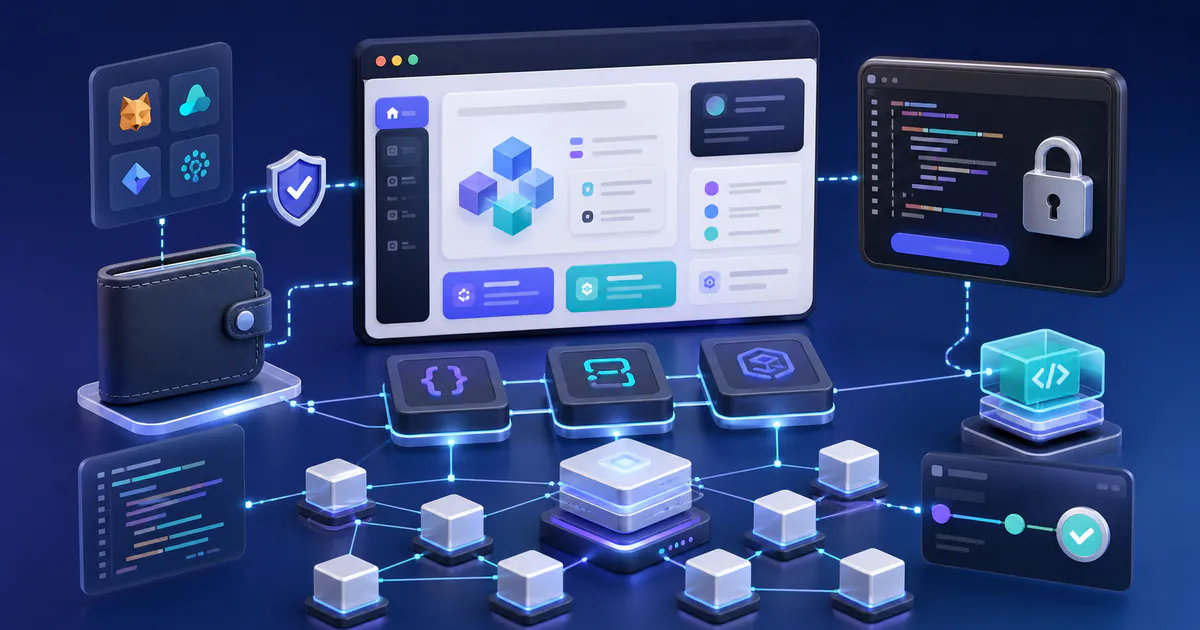
This Web3 development guide starts with the architecture behind frontend apps, backend services, wallets, smart contracts, blockchain networks, and security controls. A full-stack builder does not need to learn everything at once. The best path is to understand the system, build small dApps, and treat security as a core feature from day one.
Web3 is useful when ownership, transparency, programmable assets, or decentralized coordination matter. It is not the right answer for every app. A good developer starts by asking whether blockchain improves the product or only adds complexity.
Core Building Blocks
A typical Web3 app includes:
- A frontend built with React, Next.js, or another web framework.
- Wallet connection for user identity and transaction signing.
- Smart contracts deployed to a blockchain.
- Indexing or backend services for fast reads.
- Storage for metadata, files, or off-chain records.
The blockchain is excellent for verified state transitions. It is not designed to replace every database query in a modern app.
Smart Contracts
Smart contracts are programs that run on a blockchain. They often manage tokens, permissions, marketplaces, voting, or escrow logic. Solidity is widely used in the Ethereum ecosystem.
// SPDX-License-Identifier: MIT
pragma solidity ^0.8.20;

contract Counter {
    uint256 public count;

    function increment() public {
        count += 1;
    }
}
This example is simple, but production contracts require careful testing, access control, event design, and upgrade strategy.
Wallets and Identity
In Web3, a wallet often acts as the user's identity. The app asks the wallet to sign messages or transactions. The user controls the private key, and the app verifies the signature.
Common wallet tasks include:
- Connect wallet.
- Read account address.
- Request network switch.
- Sign a message for login.
- Send a transaction.
Never ask users for seed phrases or private keys. A legitimate dApp does not need them.
Frontend and Contract Interaction
Frontend libraries help read contract state and write transactions. The UI should be clear about what a transaction does, what network it uses, and whether gas fees apply.
const result = await contract.read.count();
await contract.write.increment();
Good Web3 UX includes loading states, transaction status, error recovery, and links to block explorers.
Security Comes First
Smart contract bugs can be expensive because deployed code often controls real assets. Security should be considered before deployment, not after launch.
Important practices include:
- Write tests for permissions and failure paths.
- Use audited libraries for token standards.
- Avoid unnecessary upgrade complexity.
- Limit admin powers.
- Add pause mechanisms only when justified.
- Get external audits for high-value contracts.
Also protect the frontend and backend. A secure contract can still be paired with a vulnerable website.
When to Use Off-Chain Services
Many dApps need off-chain infrastructure. Indexers make blockchain data searchable. Databases store user preferences. APIs prepare metadata. Background jobs respond to contract events.
Use off-chain services for:
- Search and filtering.
- Analytics dashboards.
- Email notifications.
- Rich profile data.
- Cached contract reads.
Choose Networks Carefully
Network choice affects fees, speed, tooling, liquidity, and user expectations. Testnets are useful for development, but production decisions should consider wallet support, bridge risk, community adoption, and long-term maintenance.
Do not choose a chain only because it is trending. Choose it because it fits the product.
Related Reading
- Benefits of JavaScript for Modern Web Development
- Benefits of Next.js for Modern Web Development
- Cybersecurity for Developers Secure Coding Guide
Final Thoughts
Web3 development rewards careful architecture. Keep critical ownership logic on-chain, keep user experience polished on the frontend, use backend services where they make the app faster, and never treat security as optional. Start small, test heavily, and build only what benefits from decentralization.
Keep reading
Related blogs

Web Development
AI in Next.js Development for Modern React Apps
Learn how AI in Next.js development improves React apps with server components, edge functions, automation, smarter UX, and full-stack delivery in 2026.
Read related article
Web Development
Benefits of Next.js for Modern Web Development
Discover why Next.js, React Server Components, app router, edge rendering, and AI-ready full-stack workflows drive modern web development.
Read related article
Web Development
Benefits of JavaScript for Modern Web Development
Explore why JavaScript, Node.js, React, TypeScript, and full-stack web apps remain essential for modern development and scalable products.
Read related article
Software Engineering
Future of Full-Stack Development in 2026
Explore the future of full-stack development with AI copilots, serverless, edge apps, type-safe APIs, cloud platforms, automation, and product teams in 2026.
Read related article
Cybersecurity
Cybersecurity for Developers Secure Coding Guide
Cybersecurity for developers starts with secure coding, API protection, dependency scanning, authentication, threat modeling, and DevSecOps habits for apps.
Read related article